EU13 GAMES
Social Practices of Architecture and their Political Dimension
2023-2024
Tutor: Socrates Stratis
THE EU 13 GAME: PALESTINE’S COMMONS I (2023-2024)
This year’s theme of critical play practice for the E.U. 13 Game focuses on supporting the commons on the Palestinian West Coast. The pedagogical method of the «E.U. Games» urban game series encourages students to translate the logic of critical spatial practice into a playful environment. The concept of critical spatial practice rests on the fundamental principle of the production of public space through the mediation of difference, through the enactment of dissent. Critical spatial practice is based on agonistic praxis whose aim is to bring to the realm of the sensible, hidden truths to form new questions that contest the existing status quo of spatial injustice. In advocating for Palestine’s Commons, the students had to face the following paradox: the hidden truth that they may successfully make visible in a hostile environment is immediately repressed by the current regime of control. For this reason, the students who designed and implemented two board games adopted an approach with a double performative purpose: On the one hand, they supported the Commons in Palestine in a silent and unspoken way, and on the other hand, they created a public face of camouflage. Hence, the primary purpose of the playful practice is not immediately perceived and repressed by the relevant regime of control. The first game, titled «Explore the Trail: Narrations Across Palestine», addresses the right of unrestrained access to the Palestinian territory, thanks to a network of nature trails in the West Bank, to comment on the fragmented political landscape. The second game, titled «One Bridge at a Time», deals with the assertion of multiple boundaries in a territory controlled by being utterly fragmented by the regime of control.


Explore the Trail
Team: Aaron Gatt, Georgios Louca
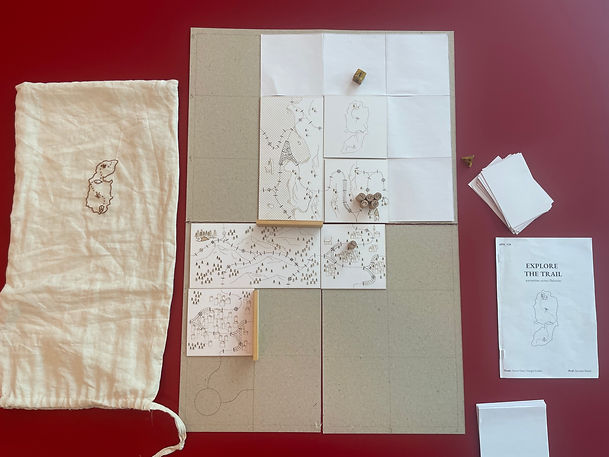
Explore the Trail is a storytelling board game. The players are invited to explore the fragmented West Bank territory by following natural trails. During their trajectory through villages, cities, deserts, forests, and coastlines, the players encounter many checkpoints, military zones, and other unforeseen events. They need to arrive together at a designated destination that may abruptly change, making their task often rather challenging. Storytelling relates to embodied experiences of the players or their colleagues, friends and family. They refer to fractured landscapes of Palestine and beyond. They are about childhood, grandparents, olive trees and the keffiyeh. The players draw the keywords written on the cards and use the stories they tell as a token to empower a collective effort in reaching the end of the board as a group. Sharing stories is contagious and handy for bypassing checkpoints and helping co-players escape from military zones. The game has been played in Nicosia (2023), Rotterdam and Eindhoven (2024), and Den Haag (2025) from which are some of the images below


One Bridge at a Time
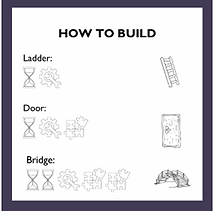
The aim of the game is to constructively transform the barriers of the region, collec tively as a group. The players need to work together to gradually remove the barriers that exist and limit the players’ access to certain freedoms and may violate their rights. The positive constructive transformation of the barriers can happen gradually with ladders, doors, and bridges. The players win the game collectively, when half of the barriers of the inner hexagon have been transformed into bridges. This is done by collecting resources such as time, labour, cooperation. In di er ent combinations and amounts, these resources will allow the players to create the necessary structures that will allow you to transform the barriers and create connec tions and shared spaces within the region. But that’s not all! Players must act collectively to discuss, negotiate, and decide their next moves before the barriers in the region become permanent! If more than half of the barriers become permanent, the players have lost the game, the system wins as they have lost complete access to certain freedoms.
Team: Andri Christophides, Athanasia Aristotelous, Theodora Demetriou