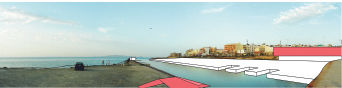
Interstititial space
Christos Pasadakis
Tutors: S. Stratis, P. Pyla, A. Antonas
The city of Heraklion follows a mode of development that meet the character of a capital. Robust growth, increased mobility, plurality of uses and large scale infrastructure forms the backdrop. The existing infrastructure of the city (Venetian walls, airport, port, highway, urban centers) and the topography of the site (river, topography) have given its current form over the course of time.
This image is not based on the realization of a master plan which could organize and guide the development, but rather on an uncontrollable embolden a dis-functional adjacencies and adverse coexisting uses. The result was the discontinuity of the in the urban fabric characterized by fragmented functions and pragmas in the city.
Realizing the shortcoming, through the real problems it is necessary to study the feasibility of the permeability of the limits. The immediate objective of this study is to achieve balance in the city and the urban functionality.
Methodology (tools): study of conditions and actions arising in the city either by official authorities or through spontaneous ownership. Fragmented analysis of Heraklion city through the observation of these statements and re-definition of this knowledge worked as the basis upon which programmatic urban uses may be exhausted by giving a new character to the city.
The ‘observation’ of the city and the conclusion that arise from the methodology used, applied in three different areas that were selected based on specific characteristics. These are the linearity, traffic flow and trans locality. The specific areas penetrate residential environment where there is coexistence and interaction. Moreover, they are strong limits of the city and despite the diversity of their character, they have been approached as ‘ways’ of mobility and use.