Reclaim the City of Emergency, Famagusta
Tutors: Socrates Stratis, Chrysanthe Constantino
2014-15
The urban design studio investigated the role of architecture in encouraging the commons in post-conflict urban environments such as that of Famagusta after the reunification of the island. It is a fragmented urban environment due to on-going ethnic and social differences. Quite often, such environments under reconstruction have an exceptional status due to the domination of urgency and safety issues. The urban reconstruction is a political process since it creates at each step new conflicts on which urban design needs to take a position. The students examined how the constitution of common spaces, that we have called third spaces, facilitates the anchoring of common activities in the urban environment, between different groups of the city’s inhabitants, and especially between Greek Cypriots and Turkish Cypriots.In this way, architecture could encourage an active co-existence and participation of the inhabitants in the creation of their city’s future. Quite often, such practices aresuppressed due to the prolonged emergency conditions caused by the activities of massive urban reconstruction. The studio explored, through the theme of urbanity, how the design of the network of third spaces could guarantee the presence of a public everydayness between different groups of inhabitants, during such prolonged period of emergency. A network of third spaces could potentially work as a transition mechanism to a smooth urban everydayness.
Domino Effect
Team: Maria Ioannou,Iraklis Papaeracleous, Zacharoula Loizou, Sofia Stylianou
In the post-conflictual situation of Famagusta and having as granted the solution of the Cyprus problem we are invited to handle this situation through the thematic “attraction points”. Our goal is to activate the entire city of Famagusta through the creation of local and peripheral attraction points in relation to the network of the city. Our goal is achieved through the Domino procedure. “Domino” is the procedure where there must be sufficient space data for the carriage of energy that is the activation of the next attraction point. The carriage of energy may refer to the entry of a programme for the creation of local spaces. In particular through strategic movements the conversion of the subordinate private space to public is achieved and thus centricity of the space are created which can comprise attraction points. In particular, in this procedure there are different paces and these in their turn affect and get affected by local and peripheral networks, which are getting stronger through a new means of transport, the tram, whose target is to improve the public transport of the city. At the same time, these paces are affected by the characteristics of the area that is the pace of the whole or the open space, the public or the private or even from the orientation of the network. For example, in the case where the elements are not enough, using architectural operations we put one more. In order for the procedure to be completed and so the next attraction point will be activated. Consequently our strategy refers to the addition (usage or infrastructures) or to total deduction in order for the Domino procedure to be successful.


Farmaround
Team: Elpida Kyriakou, Frantzeskos Zarou, Entita Orphanidou, Stefanos Christophorou
Με την διάνοιξη των Βαρωσίων μετά από ένα διάστημα περίπου 40 ετών αναμένεται η έντονη επισκεψιμότητα της Αμμοχώστου τόσο από εγχώριο πληθυσμό όσο και από τουρίστες. Η πρόταση στοχεύει στη διαχείριση αυτής της επισκεψιμότητας και τη μετατόπιση της μνήμης από την περίκλειστη πόλη των Βαρωσίων σε όλη την Αμμόχωστο. Μέσω της θεαματοποίησης τόσο της στασιμότητας των Βαρωσίων όσο και της διαδικασίας ανοικοδόμησης γίνεται προσπάθεια δημιουργίαςενός δικτύου μετακίνησης που διεισδύει στους επιμέρους θύλακες της κατακερματισμένης Αμμοχώστου. Σε πρώτη φάση το μέσο/όχημα μαζικής μεταφοράς, με συγκεκριμένο δρομολόγιο εισάγει τους επισκέπτες εντός των Βαρωσίων, τα οποία παραμένουν κλειστά. Ταυτόχρονα η ανοικοδόμηση που γίνεται εντός της περίκλειστης πόλης εξαπλώνεται σε όλη την Αμμόχωστο.
Εν συνεχεία με την υποχώρηση της έντονης επισκεψιμότητας της πόλης και την ανοικοδόμηση μεγάλου μέρους των Βαρωσίων εισάγονται σε στρατηγικά σημεία του δικτύου εφήμερα προγράμματα μεγάλης εμβέλειας που έχουν σκοπό να παρατείνουν την επισκεψιμότητα εκτείνοντας τη θεαματοποίηση και αλλοιώνοντας τη μνήμη περιοχών εντός και εκτός των Βαρωσίων. Η τοποθέτηση των περιοχών συνοδεύεται από την οριοθέτηση των χώρων μέσω του δομημένου περιβάλλοντος, της φύτευσης και της διαμόρφωσης του εδάφους.


Ground Formers (Transgressing Edge Conditions)
Team: Nasia Pantelidou, Antigoni Chrysostomou, Anastasia Demetriou , Ioanna Petrou
Introducing a public field in the city, through a landscape forming that brings together the existing educational programs, cultural buildings, and sport facilities.


Platforms of Coexistence
Team: Elena Kapakidou, Lara-Anna Scharf, Stylianna Charitou, Giorgos Syranides
Establishing a public transport area as shared spaces at one of the entries of Famagusta. Extending a park to Salamina avenue. Facilitating periodic uses together with the park&ride area, such as a market, and an open air cinema and theatre.


Shifting Infrastructures
Team: Sotiris Yiasemi, Sophia Christodoulou, Eleni Pratsi, Michaela Paschali, Eleftheria Xerou


Towards the Third Space
Team: Mpiros Andreas, Tziourrou Laoura, Tilemahou Fotios
The strategy we followed to identify the third space was firstly to find the existing polarities. The process of adapting existing polarities and the definition and redefinition of territories was with a view to obtain the third space between them, usually in urban spaces. The third space is defined by programmed segments where each one of them corresponds to its own territory. In this way the third space has the flexibility to accommodate transient programs at times. A needed condition for the selection of these programs-uses, is the existence of the concept of polarity among the areas and the extension of them located in the study area. The use of the concept is to have a constant flow movement both from regions on the perimeter, inside and outside of the study area. For example if we have a home territory outside the study area then in it we will put a kindergarten inside to create a movement between them. Also within the region we put offices premises to ensure that the movement continues to flow inside the intervention area. Our interference comes into effect mainly after the first phase of reconstruction of Famagusta. The state of emergency is treated with the expanding of the surrounding territories such as densities, uses etc. Our aim is to create a place where Greek Cypriots and Turkish Cypriots can coexist together.


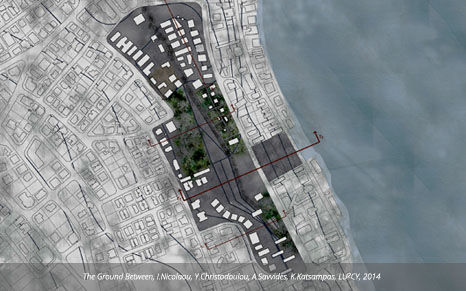
The Ground Between
Team: Iasonas Nicolaou, Yianna Christodoulou, Agamemnonas Savvides, Konstantinos Katsampas